Mutable references
For simple uses of mutable references—i.e., within a single function, and without involving loops—Verus’s proof strategy can usually track mutable references precisely and without much trouble. For example:
fn example_basic() {
    let mut a = 0;
    let a_ref = &mut a;

    *a_ref = 5;

    assert(a == 5);
}
Or:
fn example_pattern() {
    let mut a = Some(0);

    match &mut a {
        Some(inner_ref) => {
            // Obtain a reference to the contents of the Option
            *inner_ref = 20;
        }
        None => { }
    }

    assert(a === Some(20));
}
For more complex examples, we often need to write specifications about mutable references. In the rest of the section, we’ll see how to do that.
Function specifications
One of the most common ways to work with mutable references is to have a function that takes a mutable reference as an argument. In this case, we usually need a specification that relates the “input” value (i.e., the value behind the reference at the beginning of the function) to the “output” (i.e., the value behind the reference at the end of the function).
fn add_1(x: &mut u8)
    requires *x < 255
    ensures *final(x) == *old(x) + 1
{
    *x += 1;
}
In the precondition, we use *x to refer to the value behind the mutable reference at the
beginning of the function. (In this case, we use the precondition to prevent overflow from the
addition operator.)
In the postcondition, we refer to both the input value (via old) and the output value
(via final).
Aside: Could we just use
*xin the postcondition?Strictly speaking,
*xin a specification will always refer to the value pointed to byxat the beginning of the function. This is becausexis an input parameter, so just like any other input parameter, it is always evaluated with respect to its value at call time.However, we also anticipate that this might be confusing to the untrained eye—intuitively, one might expect
*xto refer to the updated value when it is used in the postcondition. Thus, Verus currently requires the developer to disambiguate by writingold(x).Historically, Verus did once allow
*xin the postcondition, where it referred to the updated value. However, this special case turned out to be incompatible with the formal theory that Verus later adopted, so this feature was removed.
Returning mutable borrows
Let’s do a more complex example, with a function that returns a mutable reference.
Specifically, let’s write a function that takes a &mut (A, B) as input and return a mutable
reference to the first field: &mut A.
fn get_mut_fst<A, B>(pair: &mut (A, B)) -> (ret: &mut A)
    requires ???
    ensures ???
{
    &mut pair.0
}

fn get_mut_fst_test() {
    let mut p = (10, 20);

    let r = get_mut_fst(&mut p);
    *r = 100;

    assert(p === (100, 20));
}
Think for a moment about how you might write a specification for get_mut_fst.
This is a little more challenging because the “final” value of pair.0 isn’t known concretely at
the end of the function. Instead, this value can be mutated by the caller who can
manipulate the returned mutable reference, ret.
Therefore, the final value of pair needs to be expressed in terms of the final value of ret.
Verus accepts the following specification for get_mut_fst, which can be used to prove get_mut_fst_test:
fn get_mut_fst<A, B>(pair: &mut (A, B)) -> (ret: &mut A)
    ensures
        *ret == old(pair).0,
        *final(pair) == (*final(ret), old(pair).1),
{
    &mut pair.0
}
Note that, even though final(ret) and final(pair) cannot be known concretely
at the end of this function (they are not known until the caller is finished with ret,
e.g., after the *r = 100; line in get_mut_fst_test),
this relation between final(ret) and final(pair) is known.
To prove get_mut_fst_test, Verus reasons roughly as follows:
fn get_mut_fst_test() {
    let mut pair = (10, 20);

    let r = get_mut_fst(&mut pair);
    //                  ^^^^^^^^^ refer to this value as `pair_ref`, of type `&mut (u64, u64)`
    //
    // From the postcondition of `get_mut_fst` we know that:
    //    *final(pair_ref) == (*final(r), 20)

    *r = 100;

    // Now we we know that:
    //    *final(r) == 100
    // So:
    //    *final(pair_ref) == (100, 20)

    // Finally, since `pair_ref` was borrowed from `pair`, and the borrow has expired
    // at this point, we can deduce that:
    assert(pair == (100, 20));
}
More examples
Here are a few more examples of functions that return mutable references.
Returning multiple mutable references:
fn pair_split<T, U>(pair: &mut (T, U)) -> ((fst, snd): (&mut T, &mut U))
    requires
    ensures
        *fst == old(pair).0,
        *snd == old(pair).1,
        *final(pair) == (*final(fst), *final(snd))
{
    (&mut pair.0, &mut pair.1)
}

fn pair_split_test() {
    let mut pair = (1, 2);
    let (fst, snd) = pair_split(&mut pair);
    *fst = 10;
    *snd = 20;

    assert(pair === (10, 20));
}
Indexing into a vector:
fn vec_index_mut<T>(vec: &mut Vec<T>, i: usize) -> (element: &mut T)
    requires
        0 <= i < vec.len(),
    ensures
        *element == old(vec)@[i as int],
        final(vec)@ == old(vec)@.update(i as int, *final(element)),
{
    &mut vec[i]
}

fn vec_index_mut_test() {
    let mut v = vec![10, 20];
    *vec_index_mut(&mut v, 1) = 200;

    assert(v.len() == 2);
    assert(v[0] == 10);
    assert(v[1] == 200);
}
Specs about borrowed data
You might wonder what happens if you try to access a variable in spec code while it’s borrowed.
fn main() {
    let mut x = 0;
    let x_ref = &mut x;

    assert(x == 0); // ??? Will this pass?

    *x_ref = 20;
}
Actually, Verus forbids this, treating it similarly to a borrow error.
error[E0502]: cannot borrow `(Verus spec x)` as immutable because it is also borrowed as mutable
  --> simple_test.rs:9:12
   |
 7 |     let x_ref = &mut x;
   |                 ------ mutable borrow occurs here
 8 |
 9 |     assert(x == 0); // ??? Will this pass?
   |            ^ immutable borrow occurs here
10 |
11 |     *x_ref = 20;
   |     ----------- mutable borrow later used here

error: aborting due to 1 previous error
The phrasing of the error message might be a little cryptic; what it’s trying to say is that you can’t read x, not even in spec code, because x is currently borrowed as mutable.
(The reason for the phrasing of the error message has to do with how Verus checks for this. Verus literally injects an artificial variable called Verus spec x into the borrow-checking pass and forces it to be borrowed for the same lifetime as x.)
However, there is still a way to read from the value of x, by using the Verus builtin operator after_borrow. This operator allows you to read a local variable at any time, but it always gives you the value x will have after its outstanding borrows expire. Working with this can often be a little unintuitive, and it is mainly useful for advanced situations.
For example, after_borrow(x) can be read even before the borrow expires:
fn main() {
    let mut x = 0;
    let x_ref = &mut x;

    assert(after_borrow(x) == after_borrow(x));

    *x_ref = 20;
}
The expression after_borrow(x), much like *final(x_ref), is not concretely known at this point.
fn main() {
    let mut x = 0;
    let x_ref = &mut x;

    assert(after_borrow(x) == 20); // FAILS

    *x_ref = 20;

    assert(after_borrow(x) == 20); // ok
}
However, much like in the specifications above, we can still describe relations between the non-concrete values:
fn main() {
    let mut x = 0;
    let x_ref = &mut x;

    assert(after_borrow(x) == *final(x_ref));

    *x_ref = 20;
}
Now, let’s see how to apply this knowledge.
Working with loops
Using after_borrow to relate local variables to mutable references can be particularly
useful when you need to write loop invariants.
Let’s do a toy example first.
Consider this (trivial) loop:
fn loop_test() -> (r: u64)
    ensures r == 30,
{
    let mut a = 0;
    let a_ref = &mut a;

    loop
        decreases 0nat
    {
        *a_ref = 30;
        return a;
    }
}
This fails due to the presence of the loop, which causes Verus to lose track of the relation
between a and a_ref. We just need to supply the relevant fact in the loop invariant.
fn loop_test() -> (r: u64)
    ensures r == 30,
{
    let mut a = 0;
    let a_ref = &mut a;

    loop
        invariant after_borrow(a) == *final(a_ref),
        decreases 0nat
    {
        *a_ref = 30;
        return a;
    }
}
The has_resolved operator: When mutable references are “done”
How does Verus know when a mutable borrow is “complete”? As we’ve seen, the creation of a mutable borrow lets us immediately reason about the “final” value of the mutable borrow, but it doesn’t become concrete until some later program point. What exactly is that point?
For any mutable reference, we say that it is “resolved” if we have reached a program point from which that reference will never be modified again.
fn main() {
    let mut x = 0;
    let x_ref = &mut x;
    *x_ref = 20;
    *x_ref = 30;

    // `x_ref` is resolved at this point

    assert(x == 30);
}
Verus provides the has_resolved operator to reason about this directly.
fn main() {
    let mut x = 0;
    let x_ref = &mut x;

    assert(has_resolved(x_ref)); // fails

    *x_ref = 20;

    assert(has_resolved(x_ref)); // fails

    *x_ref = 30;

    assert(has_resolved(x_ref)); // ok

    assert(x == 30);
}
To determine where x_ref is resolved,
Verus uses a reachability analysis that considers all program points that assign to *x_ref.
Usually, this works seamlessly under the hood to ensure that data from a mutable reference
makes it way back to the borrowed-from location. In more advanced situations (especially dealing
with containers of mutable references, like (&mut T, &mut T) or Vec<&mut T>), it helps
to be aware of this concept.
With the has_resolved operator introduced, we can fully dissect the above program to understand
how Verus confirms the assertion x == 30.
First, we need to be be aware that has_resolved(x_ref) ==> *x_ref == *final(x_ref),
i.e., “if x_ref will never be modified after this point, then its current value must equal its final value”.
With this, Verus reasons as follows:
fn main() {
    let mut x = 0;
    let x_ref = &mut x;

    // When taking a mutable reference, we get:
    // after_borrow(x) == *final(x_ref)

    *x_ref = 20;
    *x_ref = 30;

    // Here we have:
    //     has_resolved(x_ref)
    // so:
    //     *x_ref == *final(x_ref)
    //
    // And of course, at this point, we have:
    //     *x_ref == 30

    // Putting all these together we get `after_borrow(x) == 30`

    // At this point, the borrow is expired, and we can refer directly to `x`:
    assert(x == 30);
}
The has_resolved operator can be applied to any variable, not just mutable references.
This is useful for containers that contain (or might contain) mutable references.
When applied to a tuple, struct, or enum, has_resolved means that all nested mutable
references have been resolved. Such properties are provided by axioms like the following:
has_resolved::<(T, U)>((t, u)) ==> has_resolved::<T>(t) && has_resolved::<U>(u)has_resolved::<Vec<T>>(vec) ==> has_resolved::<T>(vec[i])(axiom_vec_has_resolved)
See this later chapter for more on using containers of mutable references.
Advanced application: Building a list
Finally, let’s do a more complex example to really get deeper into the mindset of thinking about mutable references in terms of the relationships between the “final values”.
Specifically, we’ll see how mutable references can be used to build up a cons-list
“from the root down”, and how to verify it.
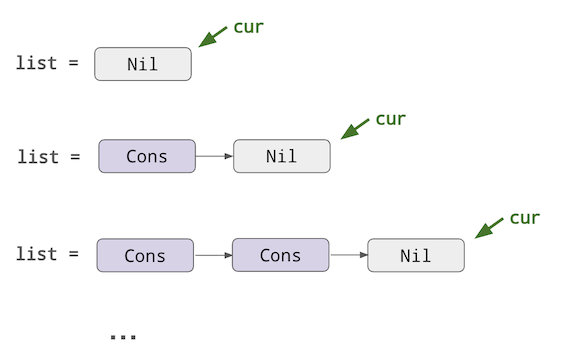
The code maintains the invariant that cur points at the Nil entry at the tail of the list, and each iteration replaces the Nil with a Cons(0, Nil). Thus, in each iteration, the list is extended by one element from the bottom, and at the end, list will be a list of length len.
enum List {
    Cons(u64, Box<List>),
    Nil,
}

fn build_zero_list(len: u64) {
    let mut list = List::Nil;
    let mut cur = &mut list;

    let mut i = 0;
    while i < len {
        *cur = List::Cons(0, Box::new(List::Nil));

        match cur {
            List::Cons(_, b) => {
                // Replace `cur` with a reference to the newly-created List::Nil,
                // the child of the previous `cur`.
                cur = &mut *b;
            }
            _ => { /* unreachable */ }
        }

        i += 1;
    }

    return list;
}
We start with the list (list) equal to Nil and take a reference to it (cur).
At each step, we replace the value pointed-to by cur with a Cons node, and then move
the reference down to the child.
Note that in this program, we both write through the cur pointer (to *cur = ...),
and we overwrite the pointer itself (cur = ...).
Here, for example, we depict the state of the program at the beginning and through
the first two iterations:
Now, let’s verify this program; in particular, let us prove that the list at the end
has length equal to the input argument, len.
Thus, our primary goal is to prove something about the value of list after the initial
borrow (cur = &mut list) expires.
The key to proving this is to observe that,
as the program progresses through the loop, the shape of this value
becomes more and more “concrete”.
- At the beginning of the loop,
curis borrowed fromlist. At this point, we have the freedom to set*curto anything we want, so we don’t know anything about the final value oflist. - After one iteration, we’ve assigned that location to be a
Consnode and replaced ourcurreference with a reference to its child. ThatConsnode is now “set in stone”; we don’t have a reference to it anymore, but we still have the freedom to set the child to whatever we want. - And so on.
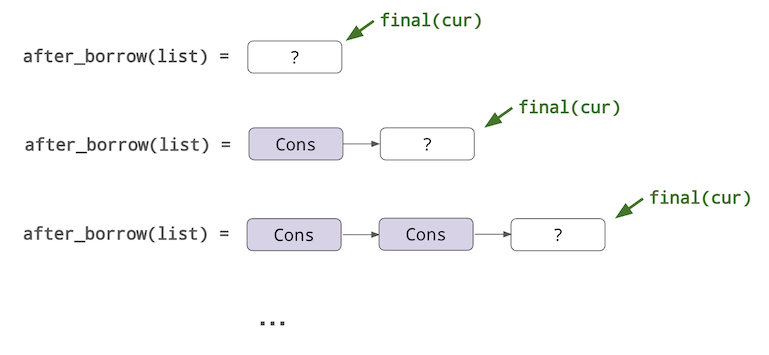
Only when the last iteration finishes and cur expires for good, do we learn that the
last node is “nil” and the list becomes fully concrete.
Now, this picture suggests that we can prove the program correct by writing an invariant
which relates final(cur) to final(list).
Specifically, we can say that final(list) will always be equal to final(cur) with
i “Cons” nodes added to the top.
enum List {
    Cons(u64, Box<List>),
    Nil,
}

spec fn append_zeros(n: nat, list: List) -> List
    decreases n
{
    if n == 0 {
        list
    } else {
        append_zeros((n-1) as nat, List::Cons(0, Box::new(list)))
    }
}

fn build_zero_list(len: u64) -> (list: List)
    ensures list == append_zeros(len as nat, List::Nil),
{
    let mut list = List::Nil;
    let mut cur = &mut list;

    let mut i = 0;
    while i < len
        invariant
            0 <= i <= len,
            *cur == List::Nil,
            after_borrow(list) == append_zeros(i as nat, *final(cur)),
        decreases len - i
    {
        *cur = List::Cons(0, Box::new(List::Nil));

        match cur {
            List::Cons(_, b) => {
                // Replace `cur` with a reference to the newly-created List::Nil,
                // the child of the previous `cur`.
                cur = &mut *b;
            }
            _ => { /* clearly unreachable */ }
        }

        i += 1;
    }

    return list;
}